Why do I need unit conversion to plan a road trip?
Maps give kilometers, cars give miles per gallon, and pumps charge by the gallon or the liter. Converting everything into matching units turns a trip into simple arithmetic: distance divided by fuel economy gives fuel, and fuel times price gives cost. One wrong unit and the budget is off by half.
- Fuel cost
- $65.24
- Fuel used
- 70.6 L
- Distance in miles
- 373 mi
- Economy (L/100 km)
- 11.8
Challenge: Plan a trip of at least 300 miles that costs $50 or less in fuel.
Play
Stretch the trip, change the car's mpg, and watch the fuel and cost update.
Challenge: Plan a trip of at least 300 miles that costs $50 or less in fuel. The box under the picture turns green when you get it.
Stuck? Pick one of the examples from the “Try an example” menu, or press “New example.”
Understand
Unit conversion is multiplying by fractions that equal 1. Since , the fraction is exactly 1, and multiplying by it changes the units without changing the distance.
After that, the trip is two steps of arithmetic:
Use
Every input has a unit menu, so you can type values in the units you already have. Results follow your units.
Show the work
- Kilometers to miles
600 \div 1.609 = 372.8\ \text{mi} - Gallons needed
372.8 \div 20 = 18.64\ \text{gal} = 70.56\ \text{L} - Cost
18.64 \times \$3.5 = \$65.24 - mpg to L/100 km
\frac{235.2}{20} = 11.76
Export
Enter the distance in km or miles, your car's mpg, and the local price per gallon. The fuel bar shows how much of a typical 16-gallon tank the trip uses.
- Real-world fuel economy is often 10–15% worse than the sticker at highway speeds.
- Link the fuel cost into the sale-price exhibit to add tax.
For learning and estimation. Verify with applicable codes, standards, and a qualified professional before using in design, construction, or safety-critical work.
Cheat card
| Symbol | Meaning | Unit |
|---|---|---|
| distance | km or mi | |
| miles per US gallon |
- Convert first, then calculate. Mixing units mid-problem is the most common mistake.
- Higher mpg is better, but lower L/100 km is better.
- A conversion factor is just a fraction equal to 1, like 1.609 km / 1 mi.
Where it’s used
- Driving & Travel
Travelers abroad convert speed limits, distances, and fuel prices between metric and US units. - Money & Shopping
Comparing a car rental’s fuel economy to your own car’s needs the same conversions.
Related exhibits
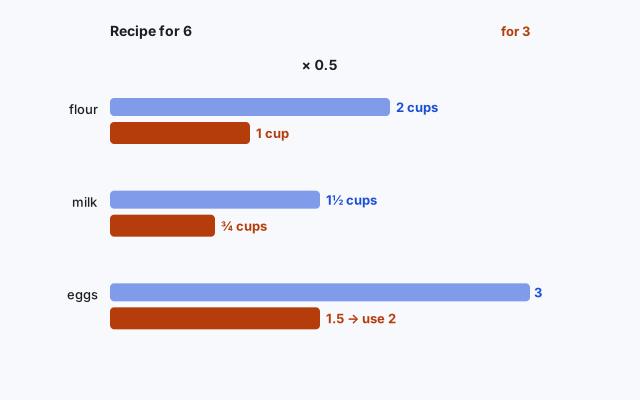 Start here
Scaling a recipe: more people, same taste
Double the guests? Every ingredient grows by the same factor.
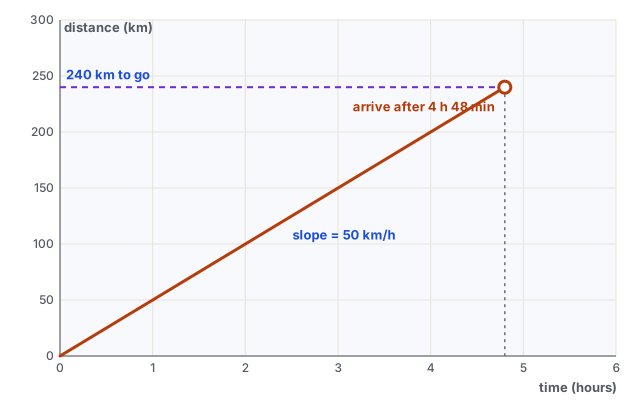 Go further
Speed, distance, time: how long is the drive?
Distance is speed times time. Rearrange it and you know when you’ll arrive.
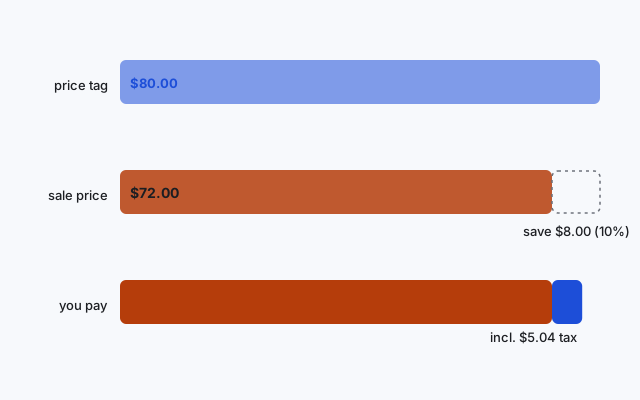 Go further
Sale price and tax: what you really pay
30% off, then tax on top. Percent math decides the number at the register.
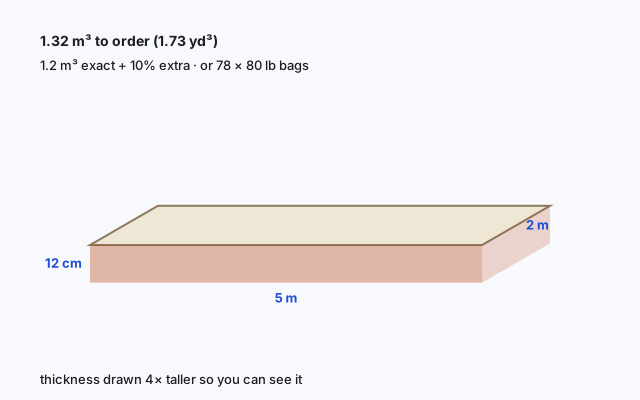 Also try
How much concrete for a slab?
Length × width × depth, plus a little extra. Get it right and you won’t run short mid-pour.
Questions people ask
How do I convert kilometers to miles?
Divide by 1.609. So 100 km is about 62 miles.
How do I convert mpg to liters per 100 km?
Divide 235.2 by the mpg. 30 mpg is about 7.8 L/100 km.
Why does a small unit mistake matter so much?
A gallon is almost four liters. Mix them up and your fuel estimate is off by a factor of four.