Why do I need geometry to pick the better pizza deal?
You pay for pizza by size, but you eat area, and area grows with the square of the diameter. An 18-inch pizza has more than twice the area of a 12-inch one. So one large can beat two mediums. Dividing price by area gives cost per square inch, which shows the real deal.
- Pizza A cost per in²
- $0.0746/in²
- Pizza B cost per in²
- $0.115/in²
- Pizza A area
- 201 in²
- All of B, area
- 226 in²
Challenge: Make both deals cost the same per square inch.
More settings
Play
Change the sizes and prices. The circles are drawn to scale, so you can see which gives you more pizza.
Challenge: Make both deals cost the same per square inch. The box under the picture turns green when you get it.
Stuck? Pick one of the examples from the “Try an example” menu, or press “New example.”
Understand
A pizza's size is its diameter, but what you eat is its area:
Because the diameter is squared, area grows much faster than size. The circles are drawn to the same scale, so you can see how much more pizza a slightly larger size gives. Dividing each price by its area gives the cost of one square inch. The lower number is the better deal.
Use
Every input has a unit menu, so you can type values in the units you already have. Results follow your units.
Show the work
- Area of a circle
A = \pi\left(\frac{d}{2}\right)^2 - Pizza A
\pi\left(\frac{16}{2}\right)^2 = 201.1\ \mathrm{in^2},\quad \frac{\$15}{201.1} = \$0.0746/\mathrm{in^2} - Pizza B
2 \times \pi\left(\frac{12}{2}\right)^2 = 226.2\ \mathrm{in^2},\quad \frac{\$26}{226.2} = \$0.115/\mathrm{in^2}
Export
Enter each pizza's size and price, and how many of pizza B you'd buy. Switch to centimeters in the unit menus if your menu lists cm.
- Thick crust or extra toppings change what you get. This compares area only.
- The same method works for anything sold by size but used by area.
For learning and estimation. Verify with applicable codes, standards, and a qualified professional before using in design, construction, or safety-critical work.
Cheat card
| Symbol | Meaning | Unit |
|---|---|---|
| diameter (the pizza size) | in | |
| area | in² |
- Double the diameter and you get 4 times the area.
- One 18″ pizza (254 in²) beats two 12″ pizzas (226 in²).
- Compare cost per square inch, not cost per pizza.
Where it’s used
- Cooking
Pizza, pies, and cakes are priced by size, but what you get is area. - Money & Shopping
The same idea compares rugs, flooring, and paint coverage by area per dollar.
Related exhibits
 Start here
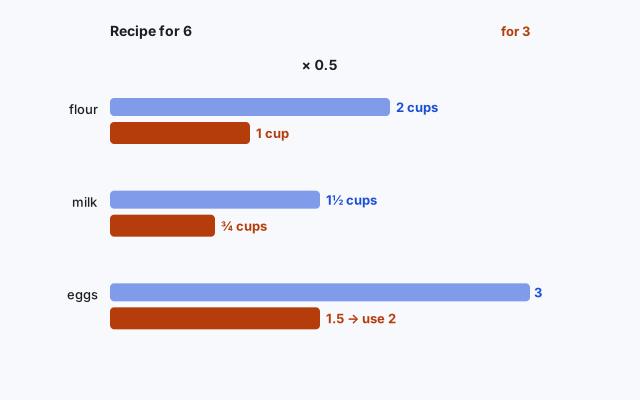
Scaling a recipe: more people, same taste
Double the guests? Every ingredient grows by the same factor.
 Go further
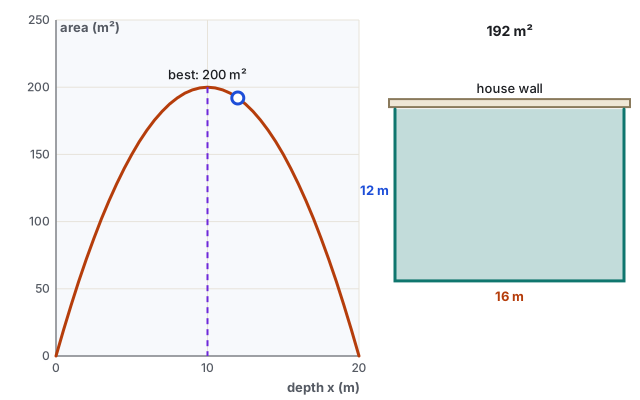
The biggest garden from a fixed fence
Same fence, different shapes. A quadratic finds the one with the most room.
 Also try
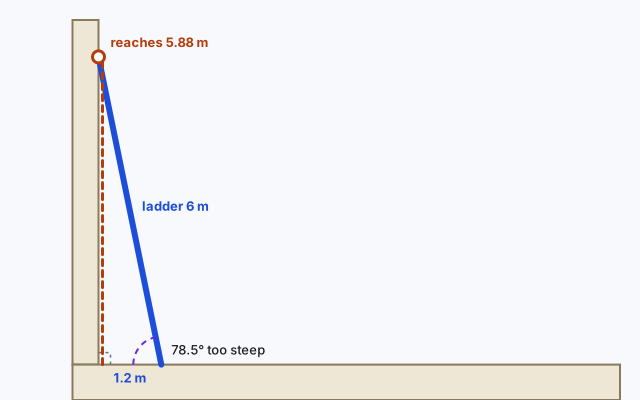
Ladder against a wall: how high will it reach?
A ladder, a wall, and the ground make a right triangle. Pythagoras does the rest.
Questions people ask
Is one 18-inch pizza more than two 12-inch pizzas?
Yes. An 18″ pizza is about 254 square inches, and two 12″ pizzas are about 226. The single large has more pizza.
How do I find the area of a pizza?
Halve the diameter to get the radius, square it, and multiply by π (about 3.14). A 12″ pizza has radius 6, so 3.14 × 36 ≈ 113 square inches.
Why does a small change in size matter so much?
Because area depends on the square of the diameter. Going from 14″ to 16″ adds about 31% more pizza, not 14%.