Why do I need the Pythagorean theorem to use a ladder?
A ladder leaning on a wall makes a right triangle with the ground. The Pythagorean theorem, a squared plus b squared equals c squared, tells you how high it reaches from its length and how far the foot is from the wall. It also checks the safe angle, about four feet up for every one foot out.
- Reaches up the wall
- 5.88 m
- Angle with the ground
- 78.5°
Challenge: Set the ladder at the safe angle (74–77°).
Play
Move the foot of the ladder closer to the wall and farther away. Watch how high it reaches.
Challenge: Set the ladder at the safe angle (74–77°). The box under the picture turns green when you get it.
Stuck? Pick one of the examples from the “Try an example” menu, or press “New example.”
Understand
The wall, the ground, and the ladder form a right triangle. The ladder is the longest side (the hypotenuse, ). The Pythagorean theorem links all three:
Move the foot out (bigger ) and the height drops. Move it in and the height rises, but so does the risk of tipping backwards. The angle at the foot is . The safe range is about 74–77°.
If is bigger than , then is negative, and no real number
squared is negative. The site shows that as #NUM!.
Use
Every input has a unit menu, so you can type values in the units you already have. Results follow your units.
Show the work
- Pythagorean theorem
a^2 + b^2 = c^2 ;\Rightarrow; a = \sqrt{c^2 - b^2} - With your numbers
a = \sqrt{6^2 - 1.2^2} = \sqrt{34.56} = 5.879\ \mathrm{m} - Angle with the ground
\theta = \cos^{-1}\frac{b}{c} = \cos^{-1}\frac{1.2}{6} = 78.46^\circ
Export
Enter your ladder's length and where you plan to put the foot. Switch between meters and feet in the unit menus.
- Extension ladders overlap. Use the extended working length, not the sum of the sections.
- The top should extend about 1 m (3 ft) past a roof edge you're climbing onto.
For learning and estimation. Verify with applicable codes, standards, and a qualified professional before using in design, construction, or safety-critical work.
Cheat card
| Symbol | Meaning | Unit |
|---|---|---|
| ladder length (the slanted side) | m | |
| foot of ladder to wall | m | |
| height reached on the wall | m |
- Safety rule: 1 unit out for every 4 units up, about 75.5°.
- The 3-4-5 triangle is a quick way to check a corner is square.
- The slanted side is always the longest.
Where it’s used
- Civil & Construction
Builders square foundations with the 3-4-5 rule and size roof rafters and ramps with Pythagoras. - Trades
Electricians, roofers, and painters set ladders safely with the 4-to-1 rule. - Home Projects
It also tells you a TV's screen size from its width and height.
Related exhibits
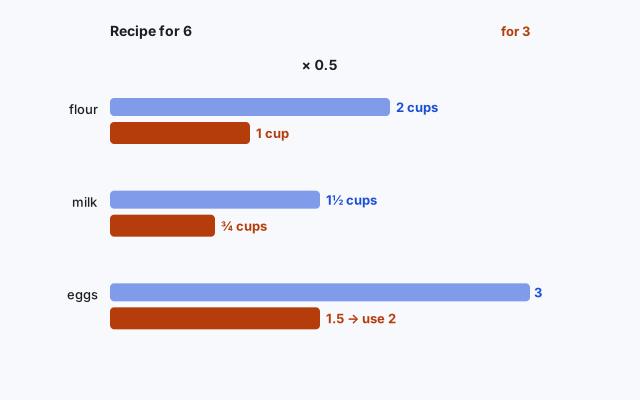 Start here
Scaling a recipe: more people, same taste
Double the guests? Every ingredient grows by the same factor.
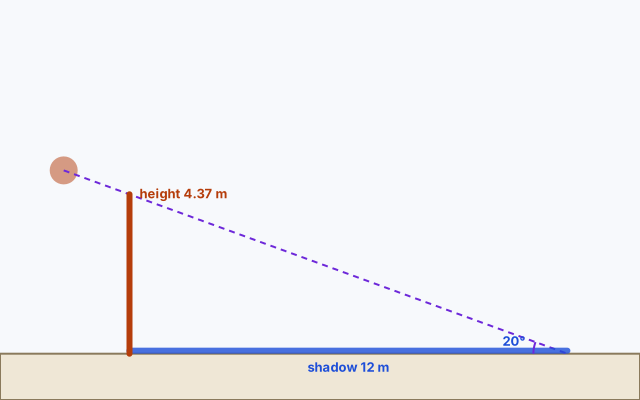 Go further
How tall is that tree? Measure its shadow
One shadow and the sun’s angle give you the height, no climbing needed.
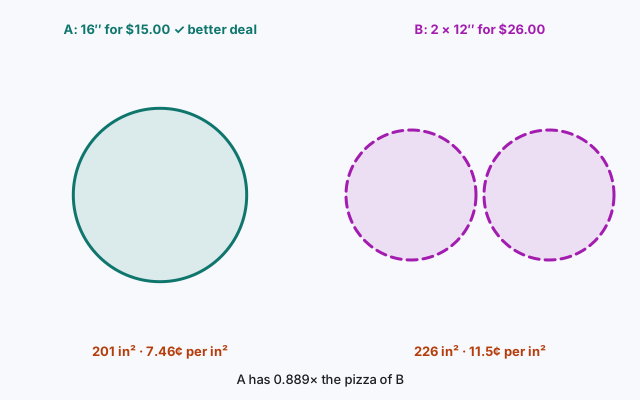 Also try
Pizza value: one large or two mediums?
Area grows with the square of the size. That changes which pizza is the deal.
Questions people ask
What is the Pythagorean theorem?
In a right triangle, the square of the longest side equals the sum of the squares of the other two. a² + b² = c².
How far from the wall should a ladder be?
About one quarter of the height it reaches. For a ladder touching the wall at 4 m, put the foot about 1 m out.
What if the foot is farther out than the ladder is long?
That's impossible, and the math agrees. You'd need the square root of a negative number, so the site shows