Why do I need probability to play board games?
Every roll of the dice is a small bet. Probability counts how many of the possible rolls give you what you need, out of all equally likely rolls. With two dice, 7 comes up six ways out of 36, more than any other total. Knowing the odds helps you pick safer moves and smarter risks.
- Chance
- 13.9%
- Winning rolls
- 5
- Possible rolls
- 36
Challenge: Find a roll you'll make about half the time.
Play
Pick how many dice and what you need to roll. The highlighted bars are your winning totals.
Challenge: Find a roll you'll make about half the time. The box under the picture turns green when you get it.
Stuck? Pick one of the examples from the “Try an example” menu, or press “New example.”
Understand
Each die has 6 faces, so dice have equally likely rolls. The chance of something is
The bars show how many rolls make each total, as a percent. The highlighted bars are the totals that win for you. Add up their heights and you get your chance. With two or more dice the bars form a hill, because middle totals can be made in more ways than extreme ones.
Use
Every input has a unit menu, so you can type values in the units you already have. Results follow your units.
Show the work
- Every roll is equally likely
\text{possible rolls} = 6^{2} = 36 - Count the winning rolls
\text{winning} = 5 - Probability
P = \frac{5}{36} = 0.1389 = 13.9\%
Export
Choose the number of dice, your target, and whether you need at least, exactly, or at most that total. The result gives the percent, the count of winning rolls, and "1 in N" odds.
- These are exact odds for fair six-sided dice. Real dice are very close.
- Each roll is independent. A long streak doesn't make any total "due."
For learning and estimation. Verify with applicable codes, standards, and a qualified professional before using in design, construction, or safety-critical work.
Cheat card
| Symbol | Meaning | Unit |
|---|---|---|
| number of dice | ||
| probability, from 0 (never) to 1 (always) |
- With two dice, 7 is the most common total (1 in 6).
- 2 and 12 each happen only 1 time in 36.
- More dice pile the totals toward the middle.
Where it’s used
- Computer Science
Game designers balance games by computing odds. Computers simulate millions of rolls to test rules. - Sports & Games
Board game and tabletop players use odds to decide when to take a risk.
Related exhibits
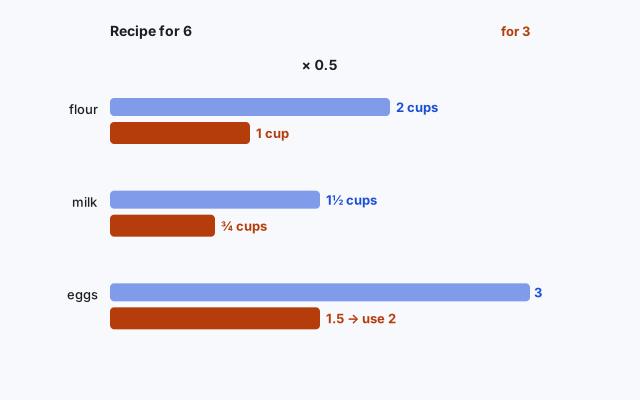 Start here
Scaling a recipe: more people, same taste
Double the guests? Every ingredient grows by the same factor.
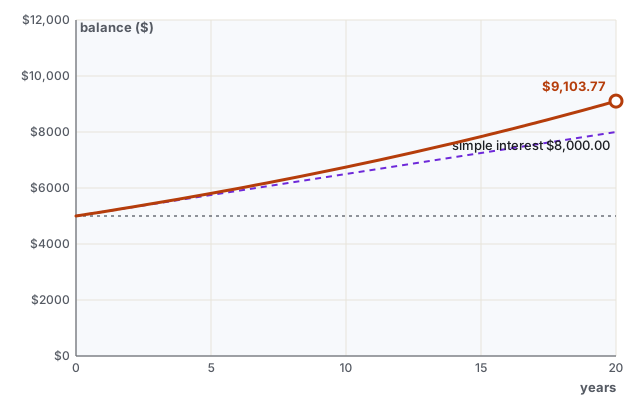 Go further
Compound interest: money that grows on itself
Interest earns interest. Exponents explain why saving early wins.
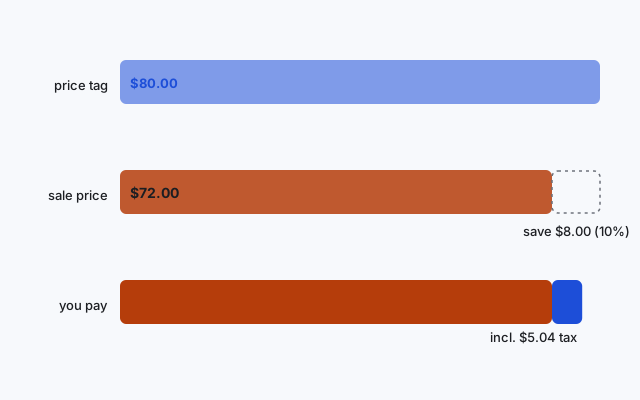 Also try
Sale price and tax: what you really pay
30% off, then tax on top. Percent math decides the number at the register.
Questions people ask
What is the most likely total with two dice?
Seven. Six of the 36 possible rolls add up to 7 (1+6, 2+5, 3+4, 4+3, 5+2, 6+1), a 1 in 6 chance.
What are the odds of rolling 8 or more with two dice?
15 of the 36 rolls, about 42%.
Why do the middle totals come up more often?
There are more combinations that add up to them. Only one roll makes 2 (1+1), but six rolls make 7.