Why do I need exponents to understand compound interest?
Compound interest pays interest on your interest, so money grows by a factor each period instead of a fixed amount. Repeated multiplication is an exponent. That's why the balance curves upward, and why starting ten years earlier can matter more than saving twice as much. The same exponent makes debt grow just as fast.
- You’ll have
- $9,103.77
- Interest earned
- $4,103.77
- Doubles every (years)
- 23.1
Challenge: Double your money.
More settings
Play
Stretch the years out. Watch the curve bend upward away from the straight line.
Challenge: Double your money. The box under the picture turns green when you get it.
Stuck? Pick one of the examples from the “Try an example” menu, or press “New example.”
Understand
Each period the balance is multiplied by . Do that times and you get an exponent:
The dashed straight line is simple interest, which adds the same dollars every year. The curve is compound interest, which adds the same percent. Early on they look alike. Over decades the curve pulls far ahead, because each year's interest is bigger than the last.
Use
Every input has a unit menu, so you can type values in the units you already have. Results follow your units.
Show the work
- Compound interest
A = P\left(1 + \frac{r}{n}\right)^{nt} - With your numbers
A = 5000\left(1 + \frac{0.03}{12}\right)^{12 \cdot 20} - Result
A = \$9103.77,\quad \text{interest} = \$4103.77 - Doubling time
t_2 = \frac{\ln 2}{n \ln(1 + r/n)} \approx 23.13\ \text{years} \quad (\text{rule of 72: } 24)
Export
Enter a starting amount, rate, and number of years. Choose how often interest is added in "More settings." The doubling time uses logarithms: .
- Real returns vary year to year. Treat long-run rates as averages, not promises.
- Inflation shrinks what the final amount can buy. Subtract it from the rate for a rough "real" answer.
For learning and estimation. Verify with applicable codes, standards, and a qualified professional before using in design, construction, or safety-critical work.
Cheat card
| Symbol | Meaning | Unit |
|---|---|---|
| starting amount | $ | |
| yearly rate as a decimal | ||
| times interest is added per year | ||
| years |
- Rule of 72: divide 72 by the rate to estimate the doubling time.
- Time matters more than rate. Early years get the most doublings.
- More frequent compounding helps, but only a little.
Where it’s used
- Finance & Business
Banks, investors, and lenders price savings accounts, loans, and retirement plans with this formula. - Money & Shopping
It shows why credit card balances snowball, and why early saving pays off.
Related exhibits
 Start here
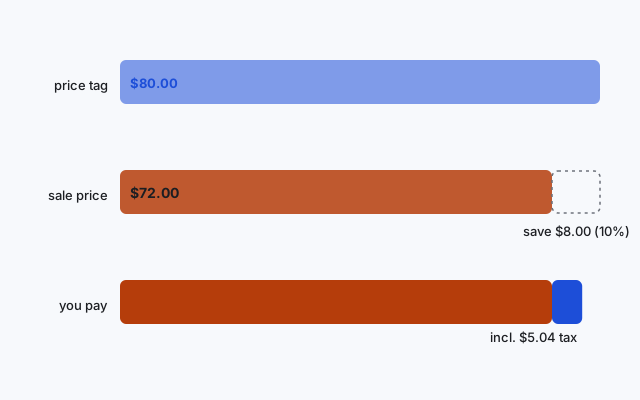
Sale price and tax: what you really pay
30% off, then tax on top. Percent math decides the number at the register.
 Go further
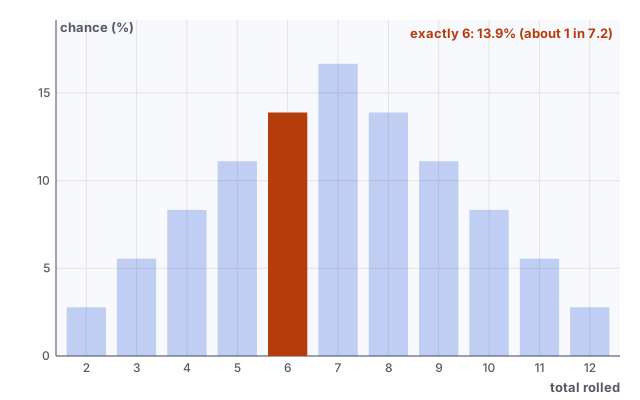
Dice odds: what are my chances of rolling it?
Why 7 shows up so often with two dice, and what that means for your next move.
 Also try
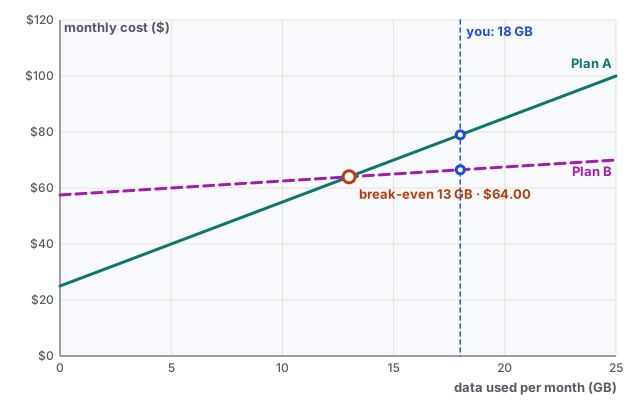
Phone plans: finding the break-even point
Two plans, two lines. Where they cross, the price is the same.
Questions people ask
What is compound interest?
Interest that is added to your balance, so the next round of interest is calculated on a bigger amount. It grows by multiplying, not adding.
What is the rule of 72?
A shortcut for doubling time. Divide 72 by the interest rate in percent. At 8%, money doubles in about 9 years.
Does compounding monthly instead of yearly make a big difference?
A small one. At 7% for 30 years, monthly compounding gives about 8% more than yearly. The rate and the number of years matter much more.