Why do I need systems of equations to pick a phone plan?
Each phone plan is a straight line: a monthly fee plus a price for every gigabyte. Setting the two lines equal is a system of equations, and solving it finds the break-even point, the usage where both plans cost the same. Below that point one plan is cheaper, above it the other plan is.
- Break-even data use
- 13 GB
- Cost at break-even
- $64.00
- Plan A at your use
- $79.00
- Plan B at your use
- $66.50
Challenge: Set your data use right at the break-even point.
Play
Slide your data use back and forth. Watch which plan's line is lower where you are.
Challenge: Set your data use right at the break-even point. The box under the picture turns green when you get it.
Stuck? Pick one of the examples from the “Try an example” menu, or press “New example.”
Understand
Each plan's cost is a linear equation: . The fee is where the line starts on the cost axis, and the price per GB is how steeply it climbs.
Two plans make a system: two equations that must both be true at the break-even point. Set them equal and solve for :
Look at the denominator. If , it is zero. You can't divide by zero,
and the graph shows why: the lines are parallel and never meet. That is a
real, useful answer (one plan is always cheaper), so the site shows it with the
code #NUM! and still counts the puzzle as solved.
Use
Every input has a unit menu, so you can type values in the units you already have. Results follow your units.
Show the work
- Cost of each plan
C_A = 25 + 3x,\quad C_B = 57.5 + 0.5x - Same cost when
25 + 3x = 57.5 + 0.5x - Collect the x terms
(3 - 0.5)x = 57.5 - 25 - Solve for x
x = \frac{32.5}{2.5} = 13\,\mathrm{GB} - Cost there
C = 25 + 3(13) = \$64 - At your data use
C_A(18) = \$79.00,\quad C_B(18) = \$66.50
Export
Any "fixed cost plus per-unit cost" comparison works the same way: rentals by the mile, gym fees per visit, subscriptions versus pay-as-you-go, or leasing versus buying equipment. Enter each option's fixed part as the fee and its per-unit part as the rate.
- Use your typical month, not your worst month, for data use.
- Taxes and fees that scale with price don't change which plan is cheaper, but they do change the dollar amounts.
For learning and estimation. Verify with applicable codes, standards, and a qualified professional before using in design, construction, or safety-critical work.
Cheat card
| Symbol | Meaning | Unit |
|---|---|---|
| data used in a month | GB | |
| monthly fee (the starting cost) | $ | |
| price per GB (the slope) | $/GB | |
| total monthly cost | $ |
- The plan with the lower fee wins at low usage. The plan with the lower price per GB wins at high usage.
- If both plans charge the same per GB, the lines are parallel and never cross. One plan is always cheaper.
- If the answer comes out negative, the lines only cross at impossible usage, so one plan always wins.
Where it’s used
- Finance & Business
Businesses use break-even analysis to find how many units they must sell before fixed costs are covered. - Money & Shopping
The same method compares gym memberships, car rentals, streaming bundles, and electricity rates.
Related exhibits
 Start here
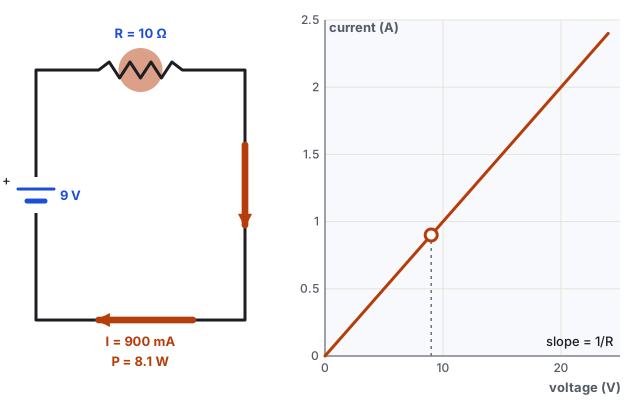
Ohm’s law: how much current flows?
Push harder (volts) or squeeze tighter (ohms), and watch the current change.
 Start here
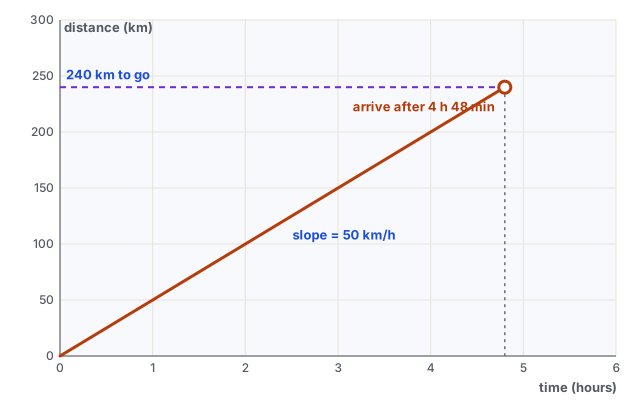
Speed, distance, time: how long is the drive?
Distance is speed times time. Rearrange it and you know when you’ll arrive.
 Go further
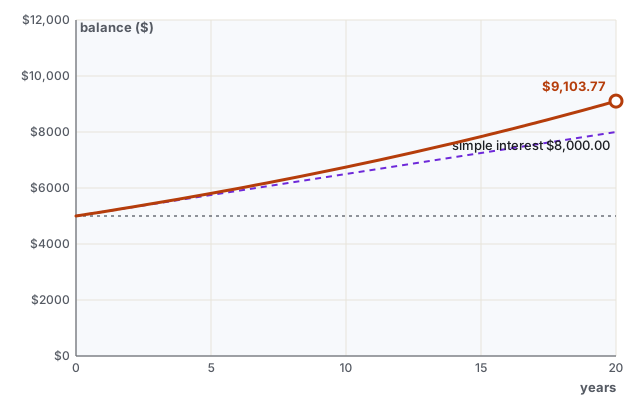
Compound interest: money that grows on itself
Interest earns interest. Exponents explain why saving early wins.
 Also try
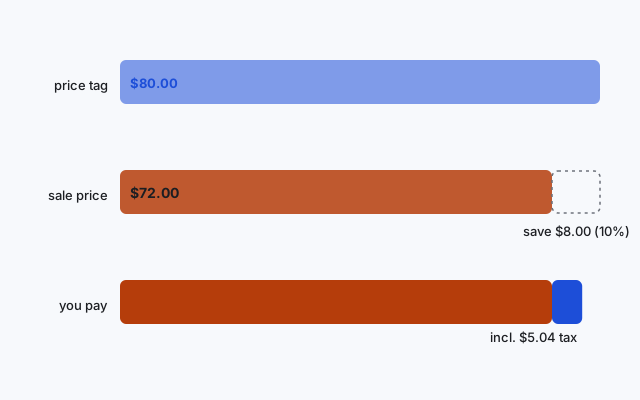
Sale price and tax: what you really pay
30% off, then tax on top. Percent math decides the number at the register.
Questions people ask
What is a break-even point?
It is the amount of use where two options cost exactly the same. On the graph, it is where the two lines cross.
What if the lines never cross?
If both plans charge the same price per GB, the lines are parallel. They never cross, so one plan is cheaper no matter how much data you use. The site marks this with the code
Why is this called a system of equations?
Because you have two equations, one per plan, that share the same unknowns, data use and cost. Solving them together means finding the one pair that works for both.