Why do I need Ohm's law?
Ohm's law, V = IR, links the push of a battery (voltage), how much a part resists (resistance), and how much electricity flows (current). With any two you can find the third. That is how you choose a resistor so an LED doesn't burn out, size a fuse, or check whether a wire will overheat.
- Current
- 900 mA
- Power (heat in the resistor)
- 8.1 W
Challenge: Get exactly 20 mA flowing, a typical LED current.
Play
Turn up the voltage to push more current. Turn up the resistance to squeeze it down.
Challenge: Get exactly 20 mA flowing, a typical LED current. The box under the picture turns green when you get it.
Stuck? Pick one of the examples from the “Try an example” menu, or press “New example.”
Understand
Ohm's law is a linear equation. Hold the resistance steady, and current is proportional to voltage:
That is a straight line through zero on the graph, with slope . A bigger resistor makes a flatter line: the same voltage pushes less current. The dot shows your circuit on that line.
In the circuit drawing, the arrow thickness follows the current, and the glow around the resistor follows the power it turns into heat.
Set the resistance to zero and the formula tries to divide by zero. There is no
answer, so the site shows #DIV/0!. In a real circuit, that is a short.
Use
Every input has a unit menu, so you can type values in the units you already have. Results follow your units.
Show the work
- Ohm’s law
V = IR ;\Rightarrow; I = \frac{V}{R} - With your numbers
I = \frac{9\,\mathrm{V}}{10\,\Omega} = 0.9\,\mathrm{A} - Power
P = VI = (9\,\mathrm{V})(0.9\,\mathrm{A}) = 8.1\,\mathrm{W}
Export
- LED resistor: . For a 5 V supply, a 2 V red LED, and 20 mA, that is .
- Resistor wattage: check and choose a part rated for at least twice that.
- Fault finding: measure V and I and compute R to spot a failing heater element or a corroded joint.
Real parts have tolerances (±1% to ±10%), and resistance changes with temperature, so leave margin.
For learning and estimation. Verify with applicable codes, standards, and a qualified professional before using in design, construction, or safety-critical work.
Cheat card
| Symbol | Meaning | Unit |
|---|---|---|
| voltage, the electrical push | V | |
| current, how much charge flows | A | |
| resistance, how hard the part pushes back | Ω | |
| power turned into heat | W |
- Double the voltage, double the current. Double the resistance, half the current.
- LED resistor: R = (supply voltage − LED voltage) ÷ LED current.
- Pick a resistor rated for at least twice the power it will actually burn.
Where it’s used
- Electrical & Electronics
Electricians and engineers use V = IR to size fuses, breakers, and wires, and to find faults with a meter. - Hobbies & Crafts
Hobbyists pick the resistor that keeps an LED at a safe current on an Arduino or a battery pack.
Related exhibits
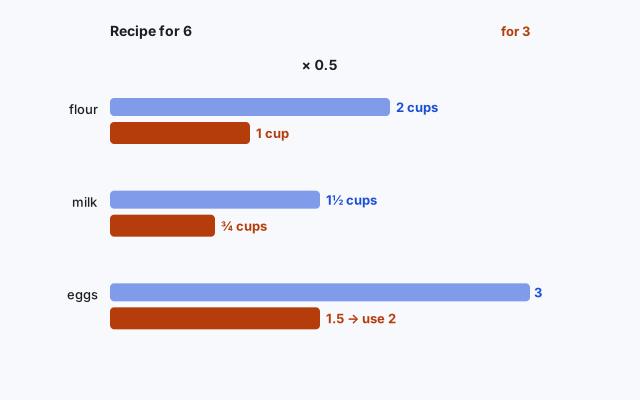 Start here
Scaling a recipe: more people, same taste
Double the guests? Every ingredient grows by the same factor.
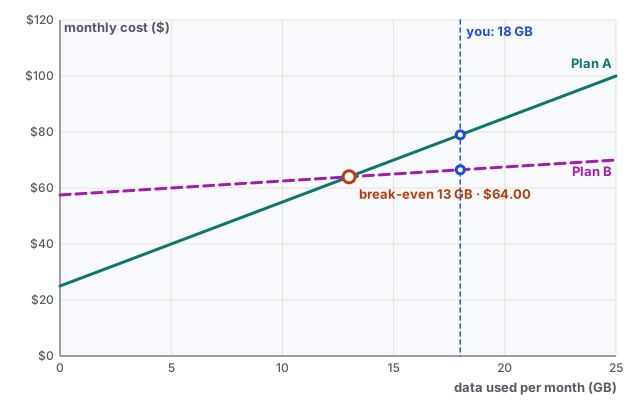 Go further
Phone plans: finding the break-even point
Two plans, two lines. Where they cross, the price is the same.
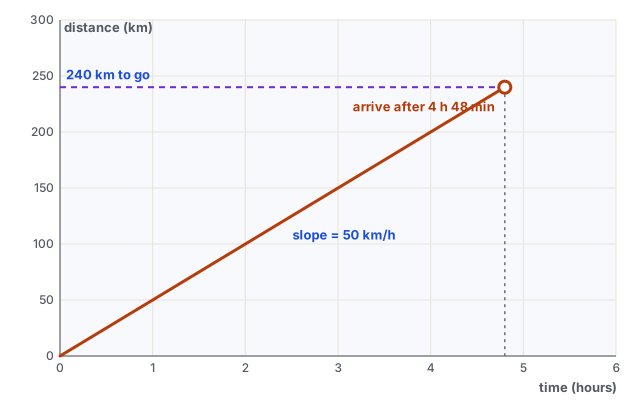 Also try
Speed, distance, time: how long is the drive?
Distance is speed times time. Rearrange it and you know when you’ll arrive.
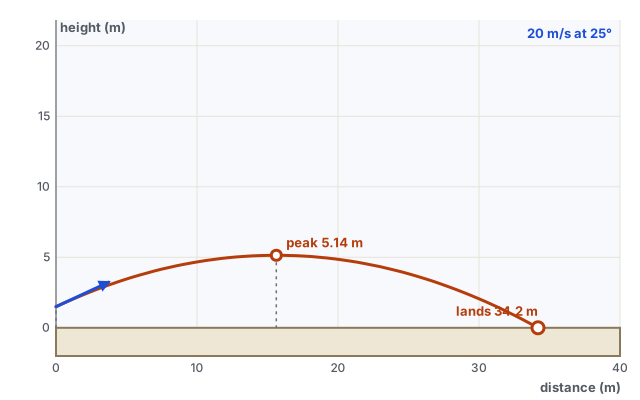 Also try
Throwing a ball: the quadratic arc
Every throw, jump, and fountain draws a parabola.
Questions people ask
What does Ohm's law say in plain words?
Current equals voltage divided by resistance. More push means more flow, and more resistance means less flow.
What happens if resistance is zero?
The formula would divide by zero, so it has no answer. In real life that is a short circuit, and the current is limited only by the battery and wires, often dangerously. The site shows this as
How do I find the power a resistor uses?
Multiply voltage by current (P = VI). You can also use P = I²R or P = V²/R. All three give the same answer.