Why do I need quadratic equations in sports?
Every thrown, kicked, or batted ball follows a parabola, the shape a quadratic equation draws. Gravity pulls the ball down at a steady rate while it keeps moving forward, so its height is a quadratic in distance. Solving that quadratic tells you how high the ball goes, how long it stays up, and exactly where it lands.
- Landing distance
- 34.2 m
- Peak height
- 5.14 m
- Time in the air
- 1.89 s
Challenge: Make the ball land past 30 m. Done!
More settings
Play
Drag the sliders to throw the ball faster or aim it higher. Watch where it lands.
Challenge: Make the ball land past 30 m. The box under the picture turns green when you get it.
Stuck? Pick one of the examples from the “Try an example” menu, or press “New example.”
Understand
The graph and the equation are the same thing. Each point on the arc is a pair — how far the ball has gone and how high it is. The equation
has three parts you can see in the picture:
- is where the arc starts: the height of your hand.
- is the straight line the ball would follow with no gravity — the direction of the blue arrow.
- is gravity bending that line down. Because it grows with , the bend gets stronger the farther the ball goes.
Written as , the peak is the vertex at , and the landing point is the root of the equation where — found with the quadratic formula.
Use
Every input has a unit menu, so you can type values in the units you already have. Results follow your units.
Show the work
- The arc (a parabola)
y = h_0 + x\tan\theta - \frac{g x^2}{2v^2\cos^2\theta} - With your numbers
y = 1.5 + x\tan 25^\circ - \frac{9.81\,x^2}{2(20)^2\cos^2 25^\circ} - As y = ax² + bx + c
y = -0.01492\,x^2 + 0.4663\,x + 1.5 - Peak (vertex)
x = -\frac{b}{2a} = 15.62\,\mathrm{m},\quad y = 5.143\,\mathrm{m} - Landing (root where y = 0)
x = \frac{-b - \sqrt{b^2 - 4ac}}{2a} = 34.19\,\mathrm{m} - Time in the air
t = \frac{x}{v\cos\theta} = 1.886\,\mathrm{s}
Export
Use this as a quick estimate for anything in free flight near Earth's surface: a thrown tool, a sprinkler jet, a jump, or a dropped payload. Switch units in the controls (m/s, km/h, mph, ft/s; m or ft) and read the peak, landing distance, and time in the air.
- The model ignores air drag and spin, so real distances are shorter, especially for light or fast objects.
- For a target at a different height than the launch, shift so the "ground" is the target's height.
- Time in the air comes from the horizontal motion: .
For learning and estimation. Verify with applicable codes, standards, and a qualified professional before using in design, construction, or safety-critical work.
Cheat card
| Symbol | Meaning | Unit |
|---|---|---|
| launch speed | m/s | |
| launch angle above the ground | ° | |
| release height | m | |
| gravity, 9.81 on Earth | m/s² | |
| distance and height of the ball | m |
- From the ground, 45° throws farthest. From a height, a slightly lower angle wins.
- Doubling the speed makes the throw about four times as long, because speed is squared.
- The peak is always halfway between the two places the arc meets the ground's height line.
Where it’s used
- Physics
Physicists model any object in free flight, from a dropped wrench to a water droplet, with the same quadratic. - Aerospace
Engineers use the no-air-resistance parabola as the first estimate for ballistic drops and payload release points. - Sports & Games
Coaches and players tune launch angle in basketball, golf, shot put, and soccer free kicks.
Related exhibits
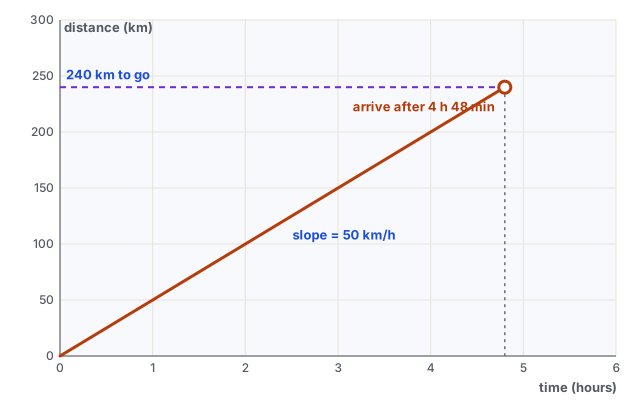 Start here
Speed, distance, time: how long is the drive?
Distance is speed times time. Rearrange it and you know when you’ll arrive.
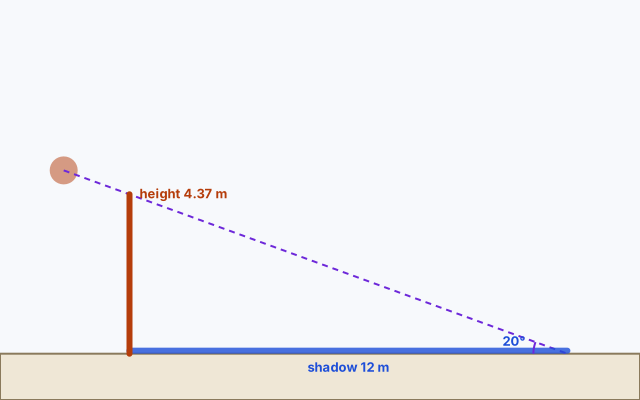 Go further
How tall is that tree? Measure its shadow
One shadow and the sun’s angle give you the height, no climbing needed.
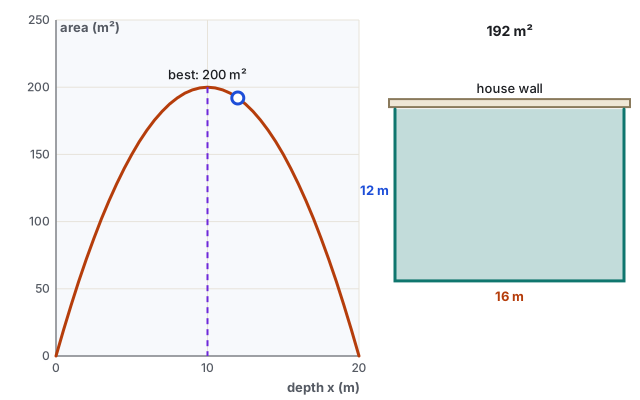 Also try
The biggest garden from a fixed fence
Same fence, different shapes. A quadratic finds the one with the most room.
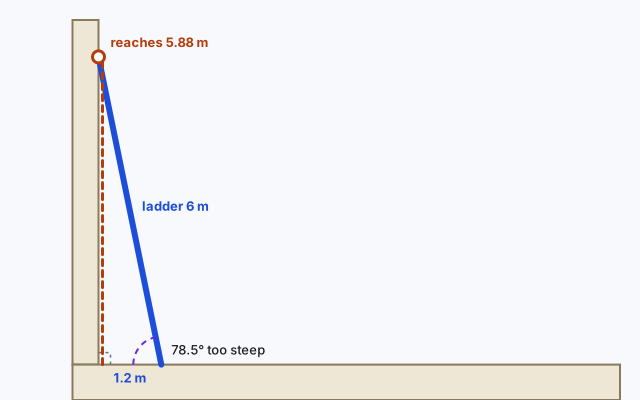 Also try
Ladder against a wall: how high will it reach?
A ladder, a wall, and the ground make a right triangle. Pythagoras does the rest.
Questions people ask
Why is the path of a ball a parabola?
Sideways, the ball moves at a steady speed. Up and down, gravity changes its speed at a steady rate. Steady-rate change makes height depend on time squared, and that squared term is what makes a parabola.
What angle throws the farthest?
From ground level and ignoring air, 45°. When you release above the landing height, the best angle is a little lower than 45°, which is why shot-putters launch at about 37–42°.
Does this include air resistance?
No. This is the classic model with gravity only. It is very close for heavy, slow objects and short throws, and it overestimates distance for light or fast objects like a badminton shuttle or a golf drive.