Why do I need ratios to choose the right wire?
A wire's resistance is its length divided by its cross-section, times a number for the metal. Double the length and resistance doubles; double the area and it halves. That ratio decides how much voltage and power a wire wastes, which is why long runs and big loads need thicker wire than the shortest-distance choice.
- Wire resistance
- 0.527 Ω
- Total conductor
- 40 m
- Cross-section
- 1.31×10^-6 m²
Challenge: Get the wire's resistance under 0.1 Ω.
More settings
Play
Stretch the cable run and switch gauges. Thicker wire (smaller AWG number) keeps the line lower.
Challenge: Get the wire's resistance under 0.1 Ω. The box under the picture turns green when you get it.
Stuck? Pick one of the examples from the “Try an example” menu, or press “New example.”
Understand
A wire resists like a long, narrow pipe resists water. Length makes it harder, cross-section makes it easier:
That's a ratio: scaled by the metal's resistivity . On the graph, each line is one gauge. Resistance grows in a straight line with length, and thicker wire (smaller AWG number) gives a flatter line.
Use
Every input has a unit menu, so you can type values in the units you already have. Results follow your units.
Show the work
- Resistance of a wire
R = \frac{\rho L}{A} - Area of 16 AWG
A = \frac{\pi d^2}{4} = \frac{\pi (1.291\,\mathrm{mm})^2}{4} = 1.309\,\mathrm{mm^2} - With your numbers
R = \frac{1.724\times 10^{-8}\,\Omega\cdot\mathrm{m} \times 40\,\mathrm{m}}{1.309\times 10^{-6}\,\mathrm{m^2}} = 0.5269\,\Omega
Export
Enter the one-way distance, the gauge, and the metal. Leave "count out and back" on for a normal two-wire circuit. Resistance is at 20 °C; hot wire resists a few percent more.
- Link this resistance into the voltage-drop exhibit to see what a run loses.
- Check local code for the minimum gauge allowed for your breaker.
For learning and estimation. Verify with applicable codes, standards, and a qualified professional before using in design, construction, or safety-critical work.
Cheat card
| Symbol | Meaning | Unit |
|---|---|---|
| resistance | Ω | |
| resistivity (copper 1.72×10⁻⁸, aluminum 2.82×10⁻⁸) | Ω·m | |
| total conductor length | m | |
| cross-section area | m² |
- Every 3 AWG sizes smaller doubles the area and halves the resistance.
- A circuit's current goes out and back, so count both wires.
- Aluminum needs about two sizes bigger than copper for the same resistance.
Where it’s used
- Electrical & Electronics
Electricians size branch circuits and feeders so long runs stay within voltage-drop limits. - Aerospace
Aircraft wiring is sized for resistance and weight together, since every gram counts. - Home Projects
It explains why a long, thin extension cord gets warm and makes tools run weakly.
Related exhibits
 Start here
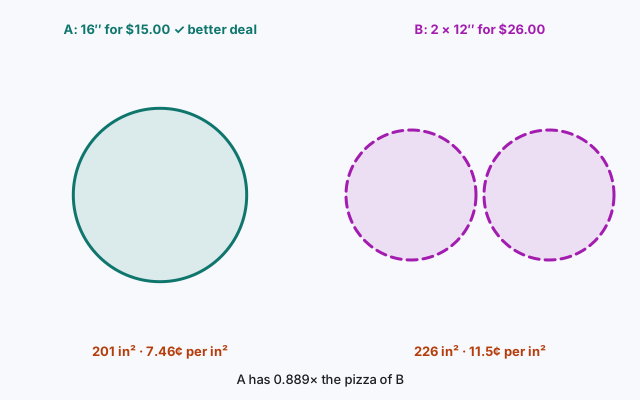
Pizza value: one large or two mediums?
Area grows with the square of the size. That changes which pizza is the deal.
 Go further
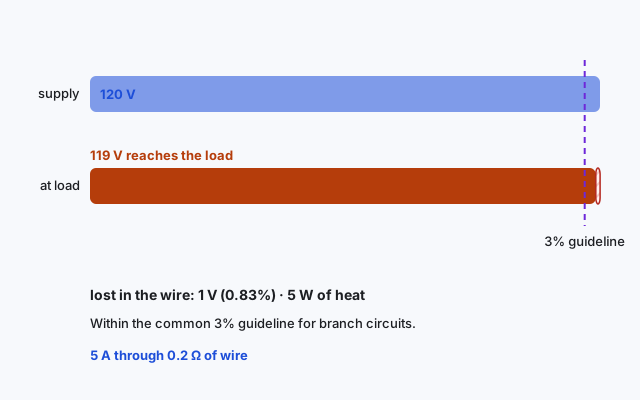
Voltage drop: what the wire takes before the load gets it
Current times wire resistance is voltage you never get to use.
 Also try
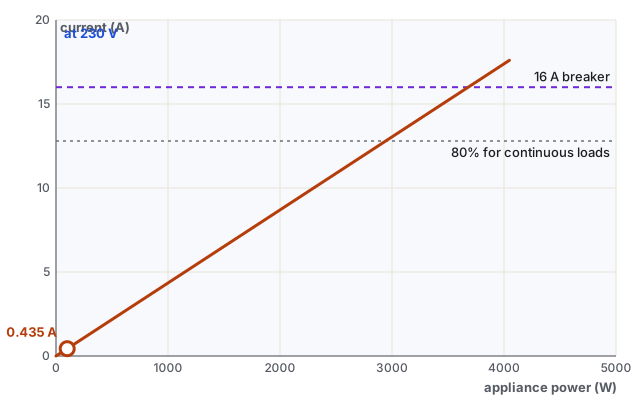
How many amps does it draw?
Watts divided by volts gives amps. That decides the breaker and the wire.
Questions people ask
Why does a longer wire have more resistance?
The electricity has farther to push through the metal. Resistance is proportional to length, so twice the length is twice the resistance.
Why is a bigger AWG number a thinner wire?
AWG counts how many times the wire was drawn through dies to make it thinner. More steps, higher number, thinner wire.
Should I count the length once or twice?
Twice for a normal circuit. Current flows out on one wire and back on the other, so both add resistance.