Why do I need the inverse-square law to light a photo?
Light spreads out as it travels, so its brightness falls with the square of the distance. Move a lamp twice as far away and the subject gets one quarter of the light, which photographers call two stops. Knowing the square rule lets you place lights on purpose instead of by trial and error.
- Brightness on the subject
- 16,000 lx
- Stops darker than the comparison
- -2
- Fraction of the comparison
- ×4
Challenge: Place the light exactly one stop darker than the comparison distance.
More settings
Play
Slide the light closer and farther. Watch how fast the brightness falls off.
Challenge: Place the light exactly one stop darker than the comparison distance. The box under the picture turns green when you get it.
Stuck? Pick one of the examples from the “Try an example” menu, or press “New example.”
Understand
A small light sends the same total light through every sphere around it. A sphere's area is , so the light per square meter falls with :
Squared means fast. Moving from 1 m to 2 m leaves of the light. In photography, each halving is one stop, so that's two stops: a logarithm, .
Use
Every input has a unit menu, so you can type values in the units you already have. Results follow your units.
Show the work
- Inverse square
E = \frac{4000}{0.5^2} = 16{,}000\ \text{lx} - Compared with the reference
\frac{E}{E_{ref}} = \left(\frac{1}{0.5}\right)^2 = 4 - In photographic stops
\log_2 \frac{E_{ref}}{E} = -2
Export
Enter the brightness at 1 m (from a light meter or the lamp's specs) and the distance. Set a comparison distance in "More settings" to see the difference in stops.
- Grow lights list PPFD at a given height; the same square rule estimates other heights.
- The rule works best at distances several times larger than the light itself.
For learning and estimation. Verify with applicable codes, standards, and a qualified professional before using in design, construction, or safety-critical work.
Cheat card
| Symbol | Meaning | Unit |
|---|---|---|
| illuminance (brightness on the subject) | lx | |
| distance from a small light | m |
- Twice the distance is a quarter of the light, or 2 stops.
- About 1.4× the distance is half the light, or 1 stop.
- Big soft lights up close don't follow the rule exactly; it's for small sources.
Where it’s used
- Physics
Gravity, radiation, and sound intensity all follow an inverse-square law. - Art & Design
Photographers and filmmakers set key and fill lights by distance. - Hobbies & Crafts
It helps position a reading lamp, a grow light, or a flash.
Related exhibits
 Start here
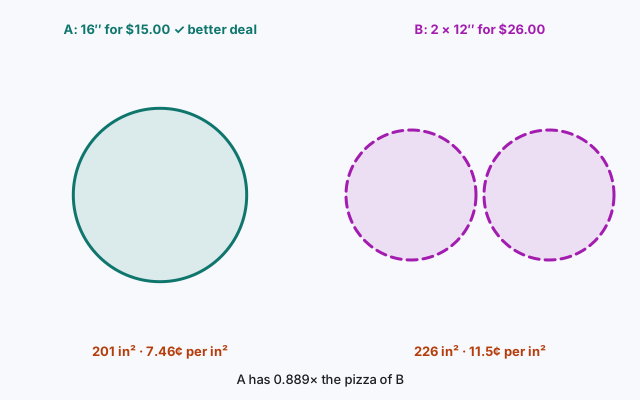
Pizza value: one large or two mediums?
Area grows with the square of the size. That changes which pizza is the deal.
 Go further
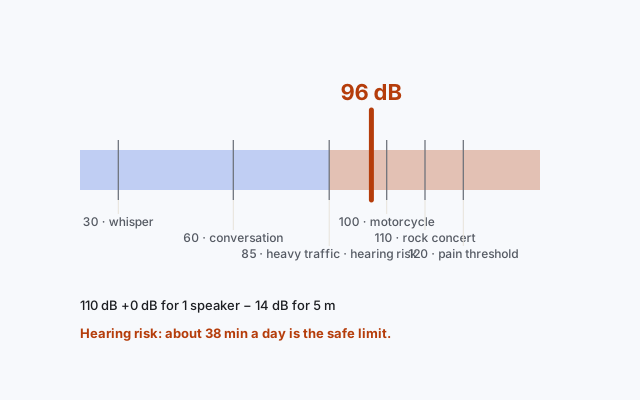
Decibels: why two speakers aren’t twice as loud
Sound is measured on a log scale. Double the speakers: +3 dB. Double the distance: −6 dB.
 Also try
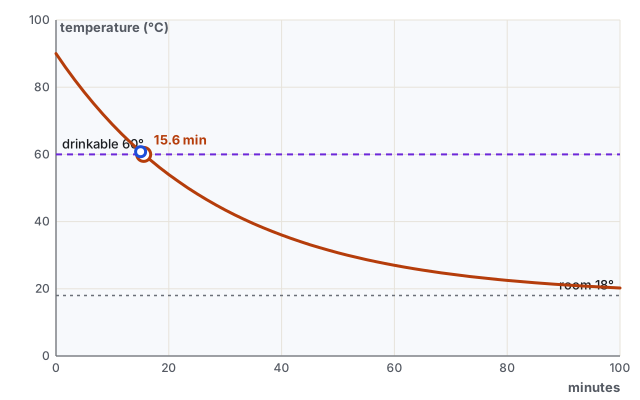
Cooling coffee: when is it drinkable?
Hot things cool fast, then slower and slower. Exponential decay predicts the sip.
Questions people ask
What is the inverse-square law for light?
Brightness from a small source is proportional to one over the distance squared. Double the distance, get a quarter of the light.
What is a stop in photography?
One stop is a doubling or halving of light. Twice the distance is 2 stops darker.
Why the square?
Light spreads over a sphere, and a sphere's area grows with the square of its radius, so the same light covers four times the area at twice the distance.