Why do I need logarithms to understand decibels?
Our ears handle a huge range of sound, so loudness is measured on a logarithmic scale called decibels. Every 10 dB is ten times the sound power. That's why two speakers add only 3 dB, and why moving twice as far away drops the level by 6 dB. It also sets how long you can safely listen.
- Level where you are
- 96 dB
- Safe listening per day (NIOSH)
- 38 min
Challenge: Find a spot just under 85 dB, the level safe for all-day listening.
Play
Add speakers and step back from the stage. Watch where the level lands on the scale.
Challenge: Find a spot just under 85 dB, the level safe for all-day listening. The box under the picture turns green when you get it.
Stuck? Pick one of the examples from the “Try an example” menu, or press “New example.”
Understand
Decibels use a logarithm so that huge ranges fit on a small scale:
Logs turn multiplying into adding. Doubling the power adds dB. Sound spreads over a sphere, so intensity falls with the square of distance, and that becomes in decibels.
Use
Every input has a unit menu, so you can type values in the units you already have. Results follow your units.
Show the work
- Adding equal speakers
10\log_{10} 1 = 0\ \text{dB} - Moving away (inverse square)
-20\log_{10} 5 = -13.98\ \text{dB} - Level where you are
110 + 0 - 13.98 = 96.02\ \text{dB}
Export
Enter one speaker's level at 1 m, how many there are, and your distance. The safe-listening time uses the NIOSH guideline (85 dB for 8 hours, 3 dB exchange rate).
- Indoors, reflections keep levels higher than the outdoor formula predicts.
- Speakers playing different content add like this on average, not at every instant.
For learning and estimation. Verify with applicable codes, standards, and a qualified professional before using in design, construction, or safety-critical work.
Cheat card
| Symbol | Meaning | Unit |
|---|---|---|
| sound level | dB | |
| number of equal sources | ||
| distance from the source | m |
- Doubling the sources adds about 3 dB; ten times as many adds 10 dB.
- Doubling the distance drops about 6 dB outdoors.
- Above 85 dB, every extra 3 dB halves the safe listening time.
Where it’s used
- Music & Sound
Sound engineers plan speaker arrays and coverage in decibels. - Physics
Decibels also measure signal strength in electronics and radio. - Health & Fitness
Hearing-safety guidelines limit daily exposure by decibel level.
Related exhibits
 Start here
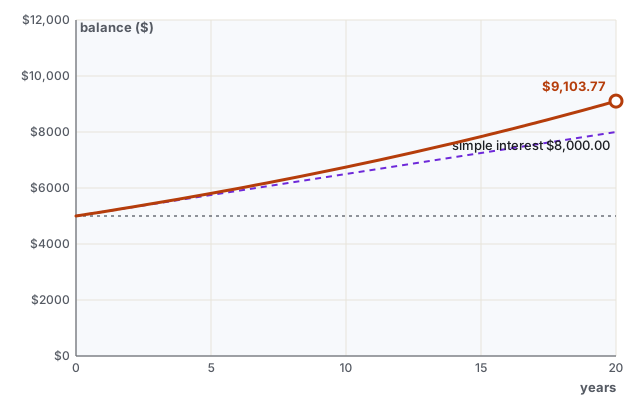
Compound interest: money that grows on itself
Interest earns interest. Exponents explain why saving early wins.
 Go further
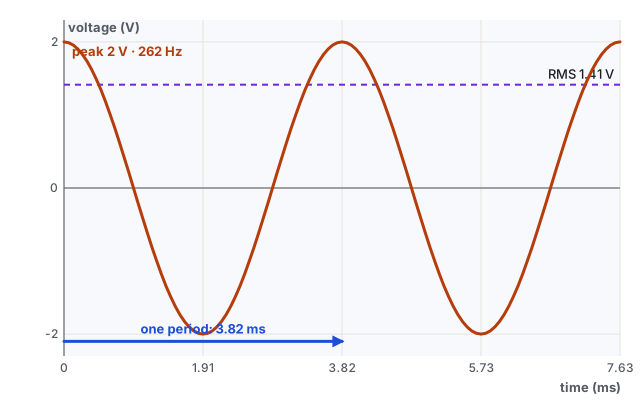
Sine waves: wall power and musical notes
The outlet and a tuning fork follow the same curve: amplitude, frequency, and phase.
 Also try
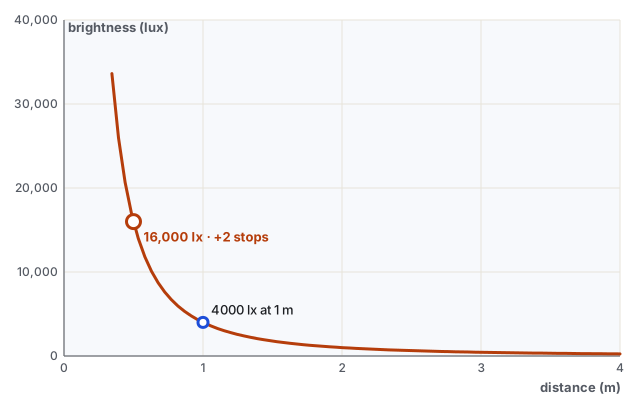
Brightness vs. distance: the inverse-square law
Move a light twice as far and it gives a quarter of the light. Photographers call that two stops.
Questions people ask
Are two speakers twice as loud?
They put out twice the power, but that's only +3 dB. To sound roughly twice as loud, you need about +10 dB, or ten times the power.
How much quieter is it when I move away?
Outdoors, each doubling of distance drops about 6 dB. Moving from 2 m to 4 m cuts 6 dB.
How loud is too loud?
NIOSH recommends at most 8 hours a day at 85 dB, halving the time for every 3 dB louder. At 100 dB that's about 15 minutes.