Why do I need sine waves to understand wall power and music?
The voltage in a wall outlet and the vibration of a musical note both follow a sine wave. Its height is the amplitude, how often it repeats is the frequency, and the RMS value is the steady voltage it acts like. That's why a 120-volt outlet actually peaks near 170 volts, sixty times a second.
- RMS (what meters show)
- 1.41 V
- Period
- 3.82 ms
- Peak to peak
- 4 V
Challenge: Set the wave to exactly 120 V RMS (the US outlet).
More settings
Play
Change the peak and the frequency. The arrow shows one full cycle.
Challenge: Set the wave to exactly 120 V RMS (the US outlet). The box under the picture turns green when you get it.
Stuck? Pick one of the examples from the “Try an example” menu, or press “New example.”
Understand
A sine wave rises and falls smoothly and repeats forever:
sets how tall it is, how many times per second it repeats, and where it starts. The time for one repeat is the period . Because the voltage keeps changing, meters report the RMS value, , the dashed line.
Use
Every input has a unit menu, so you can type values in the units you already have. Results follow your units.
Show the work
- The wave
v(t) = 2\sin(2\pi \cdot 262\,t + 90^\circ) - Period
T = \frac{1}{f} = \frac{1}{262} = 3.817\ \text{ms} - RMS
V_{rms} = \frac{A}{\sqrt{2}} = \frac{2}{1.414} = 1.414\ \mathrm{V}
Export
Pick a preset for US or European outlets, or a musical note. Frequency is in hertz. Switch the period to seconds or milliseconds in the unit menus.
- Real mains voltage varies by a few percent and is rarely a perfect sine.
- Never probe mains wiring without training and the right equipment.
For learning and estimation. Verify with applicable codes, standards, and a qualified professional before using in design, construction, or safety-critical work.
Cheat card
| Symbol | Meaning | Unit |
|---|---|---|
| amplitude (peak) | V | |
| frequency | Hz | |
| period | s | |
| phase shift | ° |
- Wall power is 60 Hz in North America and 50 Hz in most other places.
- Multiply RMS by 1.414 to get the peak.
- Doubling a note's frequency raises it one octave.
Where it’s used
- Electrical & Electronics
Electricians and engineers rate equipment in RMS volts and design insulation for the peak. - Music & Sound
Tuners, synthesizers, and audio engineers work with frequency and amplitude every day. - Music
Concert A is a 440 Hz vibration; the note an octave up is 880 Hz.
Related exhibits
 Start here
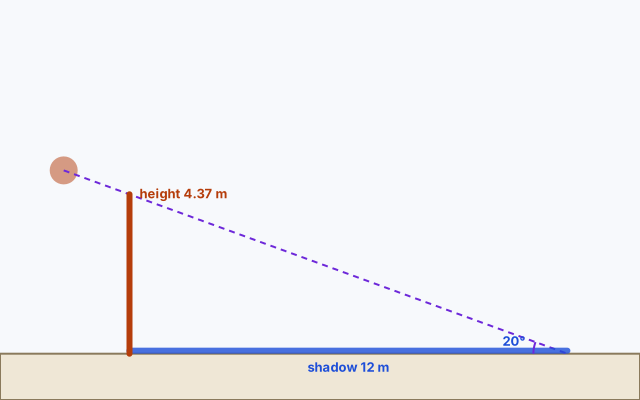
How tall is that tree? Measure its shadow
One shadow and the sun’s angle give you the height, no climbing needed.
 Go further
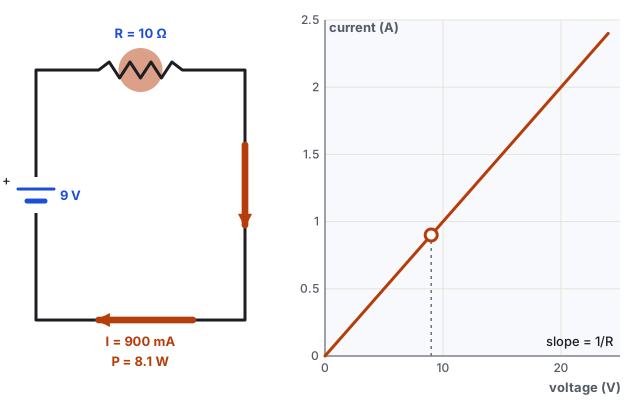
Ohm’s law: how much current flows?
Push harder (volts) or squeeze tighter (ohms), and watch the current change.
 Also try
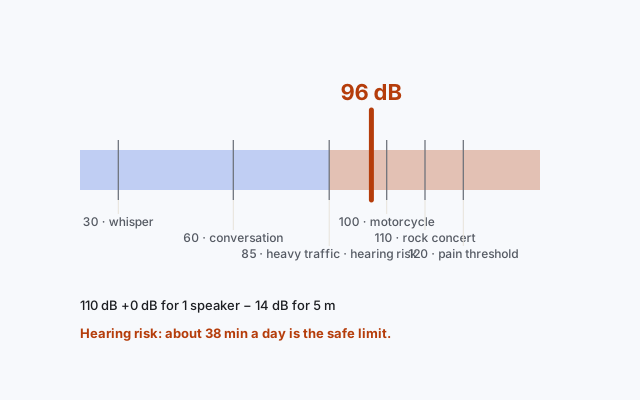
Decibels: why two speakers aren’t twice as loud
Sound is measured on a log scale. Double the speakers: +3 dB. Double the distance: −6 dB.
Questions people ask
Why is 120 V AC really 170 V?
120 V is the RMS value, the steady DC voltage that would heat a resistor the same amount. The sine wave's peak is 120 × √2 ≈ 170 V.
What is frequency?
The number of complete cycles per second, in hertz. A 60 Hz wave repeats every 1/60 of a second, about 16.7 ms.
What does phase mean?
A shift of the wave left or right in time. Two waves with a 180° phase difference cancel each other.